
Growing up, I had a close-up look at the international secondhand market through my grandmother, an aggressive businesswoman who’d hunt for treasures at local thrift shops and resell them at a steep markup—way, way before it was cool. The only difference was that her main customers weren’t based in the U.S. (where she lived for half the year), but in her native island country.
Haiti
The large-scale import of secondhand garments (known as pèpè in Haiti) began in the 1960s under U.S. trade liberalization and aid programs during the JFK administration.
Currently, pèpè is a multi-million dollar business built on thrift shop rejects from sorting warehouses in the United States, especially in cities relatively close by like Miami.
Imported garments arrive at Haitian ports packed in giant plastic-wrapped bales.

A bit of the “good”/funny side of Haiti’s secondhand economy, like customers unwittingly buying provocative or ironic graphic tees. Photos taken by Paolo Woods.

Bulk wholesalers typically purchase bales of secondhand items blindly and distribute them to thousands of Haitian market traders (machann). Yet my grandmother, like other take-charge, workaholic businesspeople, skipped the middlemen altogether.
I remember that before sending her pèpè ahead of her own arrival in Haiti, she’d spend days packing them up tightly in cardboard boxes before scrawling her name in big red or black letters all across the white tape that held a load together.
She was sourcer and machann…an entrepreneurial woman ahead of her time.
But where there’s good, there’s also bad.
Before gang violence in Port-au-Prince disrupted the industry, Haitian clothing factories produced millions of garments for American retailers, only for many of those items to later get sent back as secondhand rejects.
Plus, the country’s thriving pèpè economy has all but wiped out domestic textile industries while undercutting local tailors.
Something similar has happened in Senegal, a West African country I’d visit years later.
Senegal
Here, bustling secondhand clothing markets are stitched (see what I did there?) into daily life and known locally in Wolof as fëgg jaay, meaning “clean off and sell,” or in French as friperie.
While visiting its capital city, Dakar, in 2017, I bought a number of items from a fëgg jaay. This was almost a daily ritual for me, as I was staying in a sublet room just down the street from one of the largest of these markets in the city. Some things were as cheap as 25 cents while others were clearly a bit overpriced.
It brought to mind my grandmother holding up pairs of Jordans and Nikes, gleefully explaining how she’d resell them in Haiti for $20 to $30 a pair. That was a relatively large sum of money in the country at the time. Part of the reason she and my mother had been able to afford immigrating to the United States years prior was because of my grandmother’s financial success as a reseller.
As for the Senegalese fëgg jaay, along with providing entrepreneurial opportunities for young people and other independent merchants, it also creates work for street tailors, which includes taking used clothes, repairing and altering them, and creating highly customized, contemporary streetwear looks for both customers on the street and private clients.
However, a few years ago, Senegal’s Minister of Industry and Commerce announced plans to restrict and eventually ban the import of secondhand clothing, citing fëgg jaay’s undermining of local cotton farming, industrial weaving, and the traditional Senegalese tailoring and textile industry.


Ghana
Though it’s estimated that over 60% of the retailer side of Kantamanto Market in Accra, Ghana was destroyed by a fire early last year, it remains the world’s largest secondhand clothing market.
The clothing sold there—much of it fast fashion junk—is known locally as obroni wawu or “dead white man's clothes.”

Many of the castoffs of Kantamanto’s clothing market have infamously ended up clogging the beaches and waterways of the city and far beyond it.

These Ghanaian women are upcycling unwanted t-shirts into mop heads.
The clothes also wash into open sewers and drains, causing flooding once heavy rains come. When mountains of unwanted clothes are burned out in the open, toxins from the mostly plastic clothes are released into the air. And, of course, with such cheap clothes flooding the market, local textile economies have suffered.
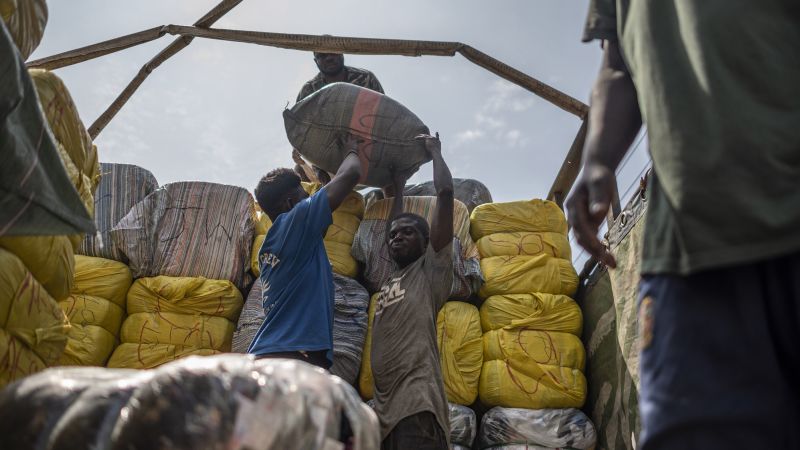
Merchants can also end up in a cycle of debt, buying clothes from wholesalers, only to open a bale and find the clothes inside stained and torn beyond repair.
My grandmother used to reject some of the clothes I tried donating to her business. With a grimace, she’d tell me in so many words, “Many Haitians might be poor, but they do have standards.”
Despite the downsides, Ghana’s overabundance of secondhand clothes is creating jobs through upcycling initiatives involving local artisans and designers.
The American-Ghanaian based Or Foundation, for instance, works to find ways to reuse textile waste in Accra. Kennie MacCarthy, a product development coordinator for Or, works with young Ghanaian women who sort through merchants’ unwanted clothes to purchase t-shirts made of cotton that they turn into mops.
Then there are the local designers turning textile waste into high fashion.

Clothes by Ghanaian upcycling brand NAKOI

It could be argued that such remedial measures aren’t enough, and I would understand that.
However, cheaply made clothes continue to be best sellers in Western countries. So, as long as we buy cheap and fast and discard just as quickly, secondhand economies in developing nations won’t be going away any time soon.
These days, my nonagenarian grandmother isn’t doing much reselling.
I reflect now on the opportunities and financial freedom it afforded her as a single woman and mother in a developing country that provided so few ways out of generational poverty.
Yes, secondhand markets in nations like Haiti are the result of a Western capitalist engine fueled by constant production and consumption, the philosophy that more is more. These second-hand markets can affect traditional, local economies while causing significant amounts of pollution.
Yet, at the same time, the balance can also tip toward something more positive. It’s a constant seesaw, you see? Out of the abundance of castoffs from wealthy countries comes the good from the bad. Jobs where there were none before. Businesses built without huge startup costs. Families able to feed themselves.
Of course, the real hope is a future where broader avenues for survival finally open up.